Column · @holdenofdp040
Comprehending Peptide Purity Testing
Peptide Purity Guide 98%, 99% & Research-grade Clarified Prg
To conclude, recognizing peptide purity degrees and grades aids you make educated decisions for your experiments. A peptide's purity percentage informs you just how much of that example is the actual deal versus spin-offs, with common research grades being around 95% approximately 98-99% for additional pureness. Analytical HPLC and MS are your friends here-- HPLC quantifies purity, and MS validates identification, together guaranteeing you know what's in your tube.- Throughout solid-phase synthesis, each amino acid coupling action has a return of approximately 99-- 99.8%.
- Residual-solvent or water-content tests can matter in manufacturing or stability contexts.
- Subtle distinctions in raw material pureness and structure can lead to incongruities in the task of the end product.
- A modern HPLC system includes several integrated elements, each offering a details function in the splitting up and detection process.
- This is the gold criterion for peptide identity-- it confirms both the make-up and the sequence.
What Can We Supply?
Not every application demands 99% pureness, and filtration is a substantial element of peptide manufacturing expense. Trace amounts of solvents utilized throughout synthesis and purification-- acetonitrile, dimethylformamide (DMF), dichloromethane-- can remain in the end product. These are generally existing at extremely low degrees in appropriately made peptides and are regulated by ICH Q3C standards for acceptable limits. If the target peptide's peak represent 99.1% of the overall height area, the peptide is reported as 99.1% pure by HPLC. Several credible study peptide providers use third-party labs; some conduct in-house testing with magazine of research laboratory qualifications.
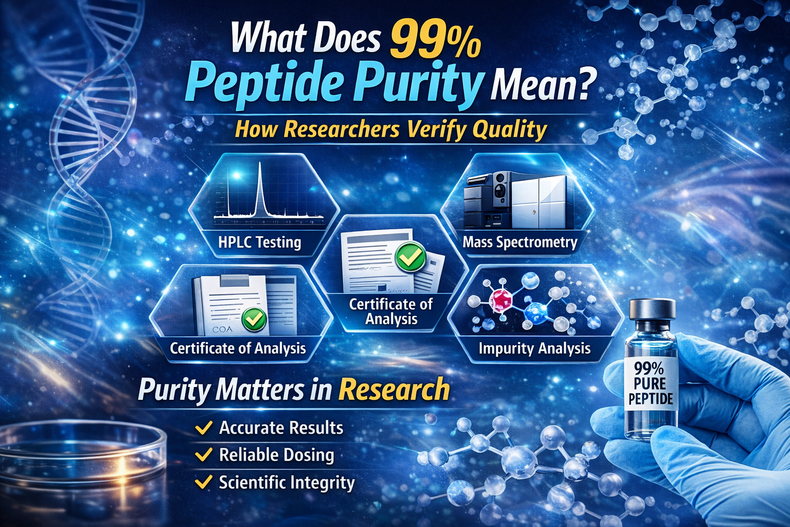
Various other strategies like electrophoresis, capillary electrophoresis (CE), and nuclear magnetic vibration (NMR) can additionally be used to evaluate peptide framework, cost, and pureness, ensuring detailed characterization. In COA evaluation, it usually includes HPLC purity screening, mass spectrometry identity verification, and batch-specific documents showing the evaluated great deal, technique, results, and day. For peptide pureness testing, reverse-phase HPLC is the conventional conceptual model. The chromatographic purity is after that calculated by comparing the location under the major optimal with the complete location under all integrated tops.
The injector presents a specific volume of example into the mobile-phase stream. Regular injection quantity issues due to the fact that straining the column can expand tops, distort pureness price quotes, or hide neighboring contaminations. A solid peptide testing process makes use of techniques that answer complementary Cellular Research inquiries. The table listed below is the useful way to think of usual examinations when reviewing a peptide COA.
Thorough Peptide High Quality Testing Services
We have the ability of serving consumers from early peptide medication exploration stages to peptide evaluation. We give all the technological info and instructions for every action of peptide synthesis and evaluation. The launch procedure of peptide formulations is complex, and an absence of clinical information prevents growth. We establish in vitro release designs, supplying full release curves and kinetic model analysis to enhance product style. Among one of the most usual resources of complication in peptide jobs is making use of different high quality terms as if they mean the very same point.
The liquified peptide sample is infused right into a stream of fluid solvent (the mobile stage) that streams with a tube packed with small fragments (the stationary stage). Different molecules "stick" to those particles with different staminas, so they travel via the column at different speeds. Refined distinctions in raw material purity and framework can result in variances in the activity of the final product. 
Also, remember Longevity Research that "research-grade" peptides are suggested for the lab bench and include high purity and identification checks however are not created as medicines. Always check that your peptide features appropriate analytical data (HPLC chromatogram and MS outcomes) and is identified for research study use. Armed with this knowledge, you can confidently translate labels like "95% purity, research study grade" and utilize those peptides to drive your experiments without confusion. Knowledge of pureness levels will additionally lead you if you ever before require a higher purity peptide for an especially sensitive assay. In the end, getting the pureness level right means a lot more reputable science-- which's the supreme goal for any kind of researcher. With years of logical screening experience and progressed tool systems, BOC Sciences supplies thorough peptide quality testing solutions throughout the whole process from basic materials to formulations.
Each peptide has a various expected molecular weight, so mass verification is not a generic badge; it is compound-specific evidence. For a much deeper identity-focused description, see Mass Spectrometry Peptide Confirmation. Identity testing confirms that what was synthesised is really the intended sequence.